

Blog


Why Use Graphite in XPS
As building energy regulations become stricter worldwide, XPS insulation manufacturers are under increasing pressure to deliver higher thermal performance, material efficiency, and long-term product stability—without significantly increasing production costs.
One proven and widely adopted solution is the addition of graphite (carbon) into XPS foam formulations.
Why Graphite Is Used in XPS Insulation
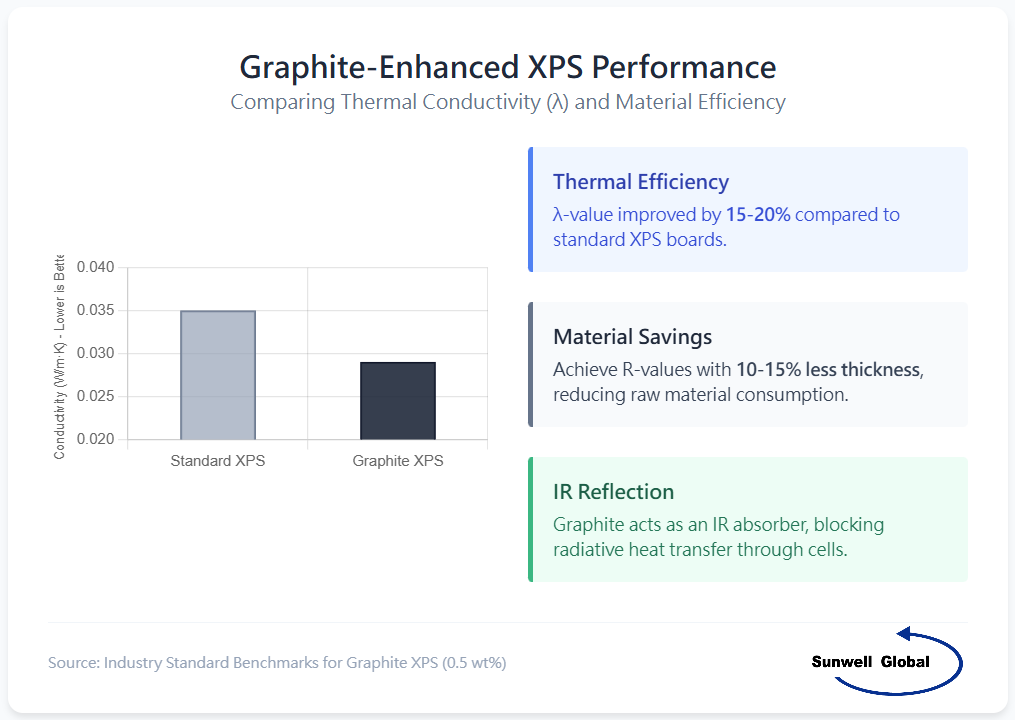
Graphite is added to XPS insulation foam primarily to reduce radiative heat transfer within the closed-cell structure.
By acting as an infrared (IR) absorber and reflector, graphite lowers the thermal conductivity (λ-value) of XPS boards. In commercial production, graphite-added XPS typically delivers a 10–20% improvement in λ-value compared to standard XPS.
For decision-makers, this translates into:
-
Achieving required insulation performance with reduced board thickness
-
Lower material usage per square meter
-
Improved long-term thermal performance after aging
-
Enhanced compliance with energy efficiency standards
How Graphite Is Added in XPS Extrusion Lines
From a production and investment perspective, graphite integration does not require a fundamentally different extrusion concept.
Graphite is normally introduced as a graphite masterbatch, dosed via:
-
The main extruder feeder, or
-
A dedicated side feeder, depending on formulation and throughput requirements
Industry practice shows typical graphite addition levels between 0.3 and 1.0 wt%, with most manufacturers operating in the 0.3–0.5 wt% range, balancing thermal performance, foam stability, and production cost.
Extrusion Line Compatibility and Investment Considerations
When planning a new XPS line or upgrading an existing one, extrusion system compatibility is a key concern.
Sunwell Global’s XPS extrusion line designs are technically suitable for graphite-added formulations, enabling:
-
Stable processing at industrial output levels
-
Consistent foam structure and board quality
-
Flexible formulation adjustment based on market and regulatory needs
This allows manufacturers to protect their investment while expanding product performance capabilities.
Conclusion
For XPS insulation producers, graphite addition offers a cost-effective and proven path to higher thermal efficiency and stronger market competitiveness.
By combining appropriate formulations with a well-designed extrusion system, manufacturers can meet evolving insulation standards without compromising productivity or operational stability.
Sunwell Global supports XPS producers with extrusion solutions aligned with modern insulation performance and long-term manufacturing efficiency.