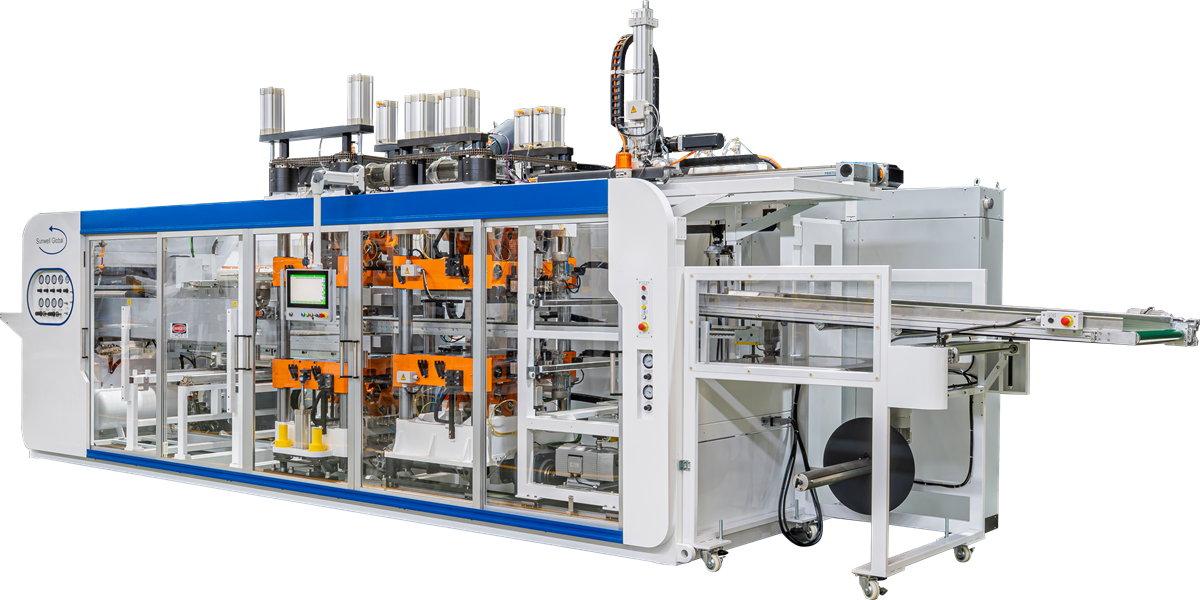


Blog


Optimizing Multi-Station Thermoforming
In the field of high-precision packaging manufacturing, thermoforming technology is undergoing a significant transformation—shifting from "volume-oriented" to "precision and sustainability-oriented." For production managers and engineers, understanding how machine architecture influences the quality of the final product is a core factor in enhancing factory competitiveness.
This article explores the technical variables that impact production efficiency when processing mainstream materials such as PP, PET, and PLA.
Material Science and the Critical Role of Temperature Control
In the thermoforming process, materials often have an extremely narrow "thermal window," meaning the temperature range between softening and melting is very brief. Take PP (Polypropylene) as an example: due to its highly regular molecular structure and crystallinity, it is exceptionally sensitive to temperature fluctuations. Even a minor deviation in temperature control can lead to unstable thermal expansion coefficients and severe post-molding shrinkage. This dimensional instability directly compromises trimming accuracy and may even lead to product deformation or cracking.
l Precise Thermal Management and Heating Uniformity
Modern high-performance equipment utilizes advanced far-infrared heating elements with an optimized matrix layout. This design allows for independent temperature control across different zones of the sheet, ensuring consistent heat distribution from the edges to the center. Such precise thermal management effectively compensates for edge heat loss caused by ambient airflow or equipment dissipation. When process temperature deviations are maintained within a critical range of ±1°C, residual internal stress is significantly minimized. Reducing this stress is vital for ensuring precise fitment and sealing integrity at the container’s closure, preventing leakage and enhancing the premium feel of the final product.
l The Challenge of Post-Consumer Recycled (PCR) Materials
As sustainability becomes a global priority, manufacturers have significantly increased the use of PCR materials. However, recycled content often contains a wider distribution of molecular weights, making its rheological properties less stable and more difficult to predict than virgin resin. In practical production, viscosity fluctuations in PCR materials can cause uneven molding pressure distribution, leading to wall thickness deviations. This requires modern thermoforming systems to feature more responsive and real-time parameter compensation. By monitoring and dynamically adjusting heating curves, manufacturers can handle the subtle physical differences between batches of recycled material while maintaining consistent output quality.
Multi-Station Architecture: The Necessity of Process Integration
Traditional single-station systems often encounter bottlenecks during the trimming and stacking phases. Modern solutions favor an "integrated multi-station" design:
l High-Precision Trimming (In-mold vs. Post-trimming):
Continuous trimming technology, whether integrated within the mold or performed immediately after forming, significantly reduces scrap offset rates. For high-clarity PET containers, precise trimming is essential to prevent visible burrs or jagged edges.
l Automated Stacking Logic:
Utilizing servo-driven stacking systems is not just about reducing labor—it is about protecting hot, freshly molded parts from deformation. This is particularly critical for lightweight (down-gauged) products that are more susceptible to physical stress during the stacking process.
Key Variables in Enhancing Machine Utilization (OEE)
Industry experience shows that frequent mold changes and repetitive process parameter adjustments are the primary sources of non-productive downtime. To maximize equipment uptime, modern systems focus on the following technical optimizations:
l Implementation of Quick Mold Change Systems (QMC)
By adopting standardized mold interfaces and rapid locking mechanisms, operators can complete physical positioning and securing in a fraction of the time. This system reduces mold changeover cycles from several hours to under 40 minutes. This significant time saving is crucial for meeting the "high-mix, low-volume" demands of the modern market, effectively shortening lead times and reducing the unit cost burden for small batch production.
l Precision Motion Control via Full-Servo Systems
Compared to traditional pneumatic or hydraulic drives, full-servo control provides highly accurate and repeatable molding pressure and velocity curves tailored to specific product geometries and material thicknesses. The "soft-start" and "soft-stop" characteristics of servo systems significantly lower mechanical impact and vibration during operation. This not only extends the service life of precision molds and machine components but also maintains quality consistency during 24/7 continuous production, drastically reducing losses due to mechanical wear and tear.
Conclusion: Technical Capability is Productivity
Thermoforming production is far more than just heating and shaping plastic sheets; it is a sophisticated integration of thermodynamics, mechanical dynamics, and material science. By optimizing heating control, enhancing automation integration, and strengthening system stability, enterprises can achieve a perfect balance between energy conservation and operational efficiency.