

Blog


Beyond the Purchase Price:
How Rigid Sheet Extrusion Line Configuration
Drives Your Total Cost of Ownership
When manufacturers evaluate a rigid sheet extrusion line, the conversation almost always starts with the same question:
What's the price? It's a fair starting point — but it's also an incomplete one. The purchase price of an extrusion line is a single data point in what is ultimately a multi-year financial equation.
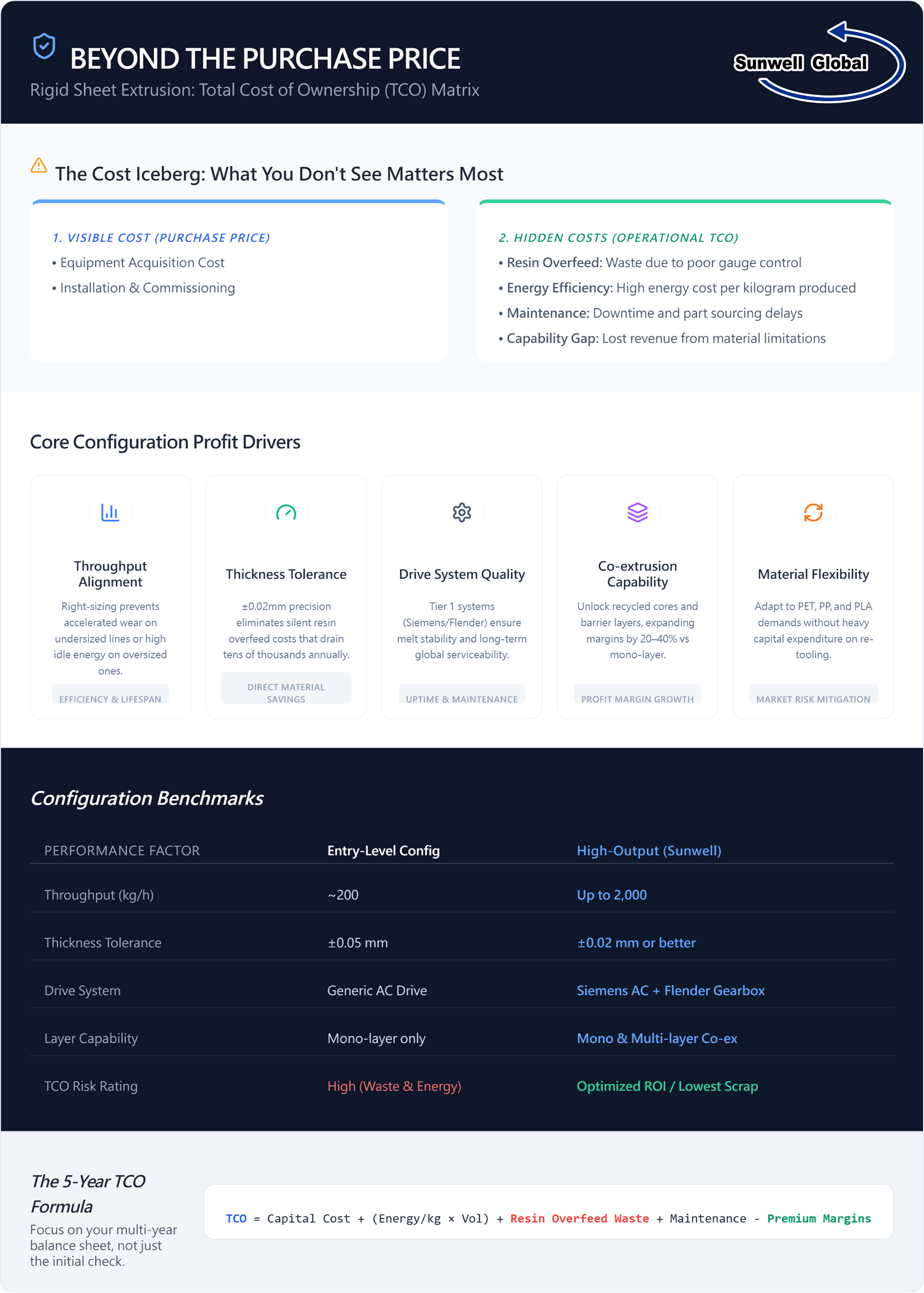
Total Cost of Ownership (TCO) tells a very different story. It accounts for the energy consumed per kilogram of sheet produced, the labor hours spent on changeovers and maintenance, the revenue lost to scrap and rework, and the margin dollars left on the table when a production line can't run the higher-value materials your customers are increasingly requesting.
This article breaks down the real cost drivers in rigid sheet extrusion — the ones that separate a line that looks affordable at purchase from one that actually delivers profit over its operational lifetime.
1. The Hidden Cost of Throughput Mismatch
One of the most common — and most expensive — configuration mistakes is selecting a line that's undersized for actual production demand. An underpowered extruder doesn't just limit output; it forces operators to run the machine at or near its ceiling, which accelerates wear on the barrel and screw, increases melt temperature variation, and compresses the window for material changeovers.
Conversely, a line that's oversized for consistent demand creates its own TCO problem: higher idle energy consumption, larger footprint costs, and more complex maintenance schedules than the operation actually needs.
The goal isn't the biggest machine — it's the right machine for your material mix, shift structure, and 3-year demand forecast.
Sunwell's Plastic Sheet Extrusion Lines span screw diameters from 50 mm all the way up to 200 mm, with throughput ranging from 200 to 2,000 kg/h. This spectrum exists precisely so manufacturers can right-size their investment rather than overpay for capacity they won't use — or underinvest and hit a ceiling before their market does.
2. Thickness Tolerance: Where Scrap Costs Hide in Plain Sight
Thickness variation is one of the largest silent cost drivers in sheet extrusion. When a line can't hold tight tolerances, two things happen: first, you produce off-spec material that must be scrapped or re-pelletized; second, to stay within spec on the thin end, you overfeed resin to compensate — meaning you're consistently using more material than the product actually requires.
Here's what that means in practice. If a line producing 500 kg/h of PET sheet runs at a tolerance that forces a 3% overfeed to avoid thin-side rejects, that's 15 kg of resin per hour disappearing into product that doesn't need it. At even modest resin prices, that adds up to tens of thousands of dollars annually.
The quality of the flat die, the calender roll stack configuration, and the precision of the temperature control system all directly determine achievable thickness tolerance. These aren't marketing specs — they're components that show up on your P&L every single shift.
• Vertical, 45° incline, horizontal, J-type, and 3rd-roll rotating calender configurations each offer different advantages for surface quality and gauge control depending on the material
• Cooling roll diameter (from 300 mm to 900 mm available) affects dwell time and thermal uniformity across the sheet width
• Die lip adjustment systems — manual or automatic — determine how quickly operators can re-center gauge after a material or speed change
3. Drive System Quality and Its Long-Term Consequences
The drive system is the heartbeat of the extrusion line. It governs screw speed stability, energy efficiency, and how gracefully the machine handles acceleration and deceleration during startups and material transitions.
Generic or low-specification drive systems introduce speed variation that creates melt pressure fluctuations — and melt pressure fluctuations create thickness bands across the sheet. Beyond quality, they're also maintenance liabilities: components sourced from fragmented supply chains are harder to service globally and often carry shorter mean-time-between-failure ratings.
Sunwell's lines are built with Siemens AC drives paired with Flender gearboxes — or equivalent industrial-grade alternatives. This isn't a cosmetic choice. Siemens and Flender are globally serviced, carry long parts availability horizons, and are engineered for the continuous-duty cycles that a high-output extrusion line demands. When your line runs 6,000+ hours per year, the difference between a Tier 1 drive and a generic one becomes measurable in both uptime and maintenance costs.
4. Co-Extrusion Capability: Unlocking Margin Through Material Strategy
Single-layer sheet gets the job done for commodity applications. But the rigid sheet packaging market is increasingly driven by multi-layer structures — barrier layers, tie layers, recycled content cores, and surface layers engineered for specific print or seal performance.
A line configured for co-extrusion doesn't just expand your material options — it expands your customer base and your margin structure. Multi-layer sheet commands pricing premiums because it delivers properties that mono-layer structures simply can't match:
• APET/PE or APET/PP co-ex structures for sealing without adhesives
• rPET core layers with virgin PET skins for food-contact compliance with recycled content
• Barrier layer structures for oxygen-sensitive food applications
• HIPS/PE multi-layer combinations for enhanced thermoforming performance
The upfront capital cost of a co-extrusion system — additional extruders, feedblock or multi-manifold die, more complex control architecture — is real. But the margin per kilogram of multi-layer sheet versus mono-layer can easily be 20–40% higher depending on the market. That differential typically makes the co-ex configuration pay for itself faster than manufacturers expect.
A line that can only run commodity mono-layer sheet will always be competing on price.
A line that can run specialty multi-layer structures competes on capability.
5. Material Flexibility and the Cost of Being Locked In
Many manufacturers start a project with a single material in mind — PET for food trays, PP for microwave containers, HIPS for dairy packaging. But the market doesn't stay still. Sustainability regulations are reshaping material preferences faster than most capital investment cycles. The move toward rPET, the growing interest in PLA for certain applications, and retailer sustainability mandates are all creating material transitions that some lines simply aren't equipped to handle.
A line configured for rigid PET sheet that can't process PP without significant mechanical changes locks you in to a single material at exactly the moment the market is rewarding flexibility. When evaluating a rigid sheet extrusion line, it's worth asking not just what materials the line runs today, but what material transitions it can accommodate with tooling swaps rather than capital expenditure.
Sunwell's Plastic Sheet Extrusion Lines are designed to process PS, PP, PET, PLA, and other rigid sheet polymers — with line configurations adaptable to material-specific screw geometries, barrel temperatures, and die designs. That flexibility is worth pricing explicitly into a TCO model.
6. Configuration Comparison at a Glance
The table below summarizes how different configuration tiers map to key TCO drivers:
|
TCO Factor |
Entry-Level Config |
Mid-Range Config |
High-Output Config (e.g., Sunwell) |
|
Screw Diameter |
65 mm |
90–100 mm |
120–200 mm |
|
Throughput |
~200 kg/h |
400–800 kg/h |
Up to 2,000 kg/h |
|
Energy per kg |
High |
Moderate |
Optimized / Lower |
|
Layer Capability |
Mono only |
Mono / basic co-ex |
Mono & multi-layer co-ex |
|
Thickness Tolerance |
±0.05 mm or wider |
±0.03–0.04 mm |
±0.02 mm or better |
|
Drive System |
Generic AC drive |
Branded AC drive |
Siemens AC + Flender gearbox |
|
Scrap Rate Impact |
Higher |
Moderate |
Minimized |
7. Winding and Downstream Configuration: Often Overlooked, Always Consequential
The extruder and die get most of the specification attention, but the downstream handling system — slitting, winding, or in-line thermoforming feed — is where a lot of operational efficiency is actually determined.
A winder that requires manual roll changeovers on a high-speed line creates labor bottlenecks and introduces downtime that accumulates to hundreds of hours per year. An automatic turret winder that executes cutover without stopping the line represents a capital premium that pays off quickly in a continuous production environment.
Similarly, in-line integration with thermoforming eliminates the reheat energy required when running extrusion and thermoforming as separate operations. For high-volume producers, this thermal integration can reduce energy costs by a meaningful margin — and it eliminates the material handling, storage, and logistics costs associated with an offline extrusion-to-thermoforming workflow.
Sunwell's extrusion lines are designed for direct in-line integration with their thermoforming machine range, offering manufacturers a continuous production path from resin to formed part without intermediate handling.
8. Building a TCO Model Before You Buy
The most effective way to evaluate a rigid sheet extrusion line investment is to build a simple TCO model before the purchase decision. It doesn't need to be elaborate — a 5-year projection covering the following variables will surface the meaningful differences between configurations:
1. Capital cost (equipment + installation + commissioning)
2. Energy cost per kg at expected production volume
3. Resin overfeed cost due to gauge tolerance
4. Scrap rate and re-pelletizing costs
5. Maintenance and parts costs (factoring in drive system serviceability)
6. Revenue opportunity cost of material limitation (mono vs co-ex)
7. Downtime cost at your margin per production hour
When you run these numbers across a 5-year horizon, the cheapest line at purchase rarely wins the TCO comparison.
The Bottom Line
A rigid sheet extrusion line is not a commodity purchase. It's a production asset that will shape your cost structure, your material strategy, and your competitive positioning for a decade or more. Treating it as a price-per-machine decision — rather than a full TCO analysis — is one of the most expensive mistakes a manufacturing operation can make.
Sunwell Global engineers its Plastic Sheet Extrusion Lines with these long-term economics in mind: precision thickness control, industrial-grade drive systems, flexible material compatibility, and seamless downstream integration. The goal isn't to sell the lowest-priced machine — it's to deliver the best return over the life of the investment.
If you'd like to work through a TCO analysis for your specific production requirements,
Sunwell's engineering team is available to help you model the numbers before you commit to a configuration.
Learn more at www.sunwellglobal.com.tw
Contact: +886-4-853-4810